
Clark County Divorce Decree Records
Clark County divorce decree records are kept by the County Clerk at the Superior Court in Vancouver. If you need to search for a dissolution case or get a certified copy of a decree, the Clark County Clerk's office is your main point of contact. The clerk handles all family law filings for the county, including petitions, final decrees, and parenting plans. You can search online through the Odyssey portal or visit the courthouse in person. Mail and email requests are also accepted for copies.
Clark County Overview
Clark County Superior Court Clerk
The Clark County Superior Court Clerk handles all dissolution records for the county. Scott G. Weber serves as the County Clerk. The office stores case files, processes copy requests, and provides access to both current and archived records. Staff can look up cases by name or case number and help you get the documents you need. The public access terminal is open during office hours for in-person searches at no charge.
Clark County is the second most populous county in Washington, covering Vancouver and surrounding communities near the Oregon border. All dissolution cases for residents of Clark County are filed here. The clerk's office has been maintaining court records since September 1909. For older records going back further, you may need to contact the clerk directly about archive options.
| Office | Clark County Superior Court Clerk |
|---|---|
| Clerk | Scott G. Weber |
| Address |
1200 Franklin Street Vancouver, WA 98660 Mailing: PO Box 5000, Vancouver, WA 98666-5000 |
| Phone | (564) 397-2292 |
| Public Records Officer | Cheryl Stone, (564) 397-2150 |
| copyrequests@clark.wa.gov | |
| Hours | Monday through Friday, 9:00 AM to 12:00 PM and 1:00 PM to 4:30 PM |
| Website | clark.wa.gov/clerk |
The Clark County Access to Records page explains how to request copies and what information you need to provide. The office also has a public records officer for formal public records act requests. For divorce decree copies specifically, contact the main clerk line or email directly.
How to Find Clark County Divorce Decree Records
Clark County offers several ways to search for dissolution records. The fastest is the online Odyssey portal, which has case data from 1990 to the present. You can search by party name or case number and see docket entries, case status, and filing dates. The Clark County Superior Court records search is another portal you can use from any device. Both are free for basic lookups.
For cases filed before 1996, records are held on microfilm at the clerk's office. There is an extra $30 search fee for archived pre-1996 records when no case number is provided. For pre-1979 cases, a $30 research fee also applies. If you have the case number, it goes faster. Bring it with you or include it in your request to avoid delays.
The statewide Washington Courts case search also covers Clark County and lets you look up cases across multiple counties in one search. This is useful if you are unsure which county a case was filed in.
To search or request records, have the following ready:
- Full names of both parties (last name, first name format)
- Case number if you have it
- Approximate year the case was filed
- Sub-number if requesting specific documents
- Type of copy needed (certified or non-certified)
Note: Providing the case number whenever possible speeds up processing and avoids extra search fees.
Clark County Clerk and Records Access
The Clark County Clerk official website provides full details on how to request records, download copy request forms, and contact the office.
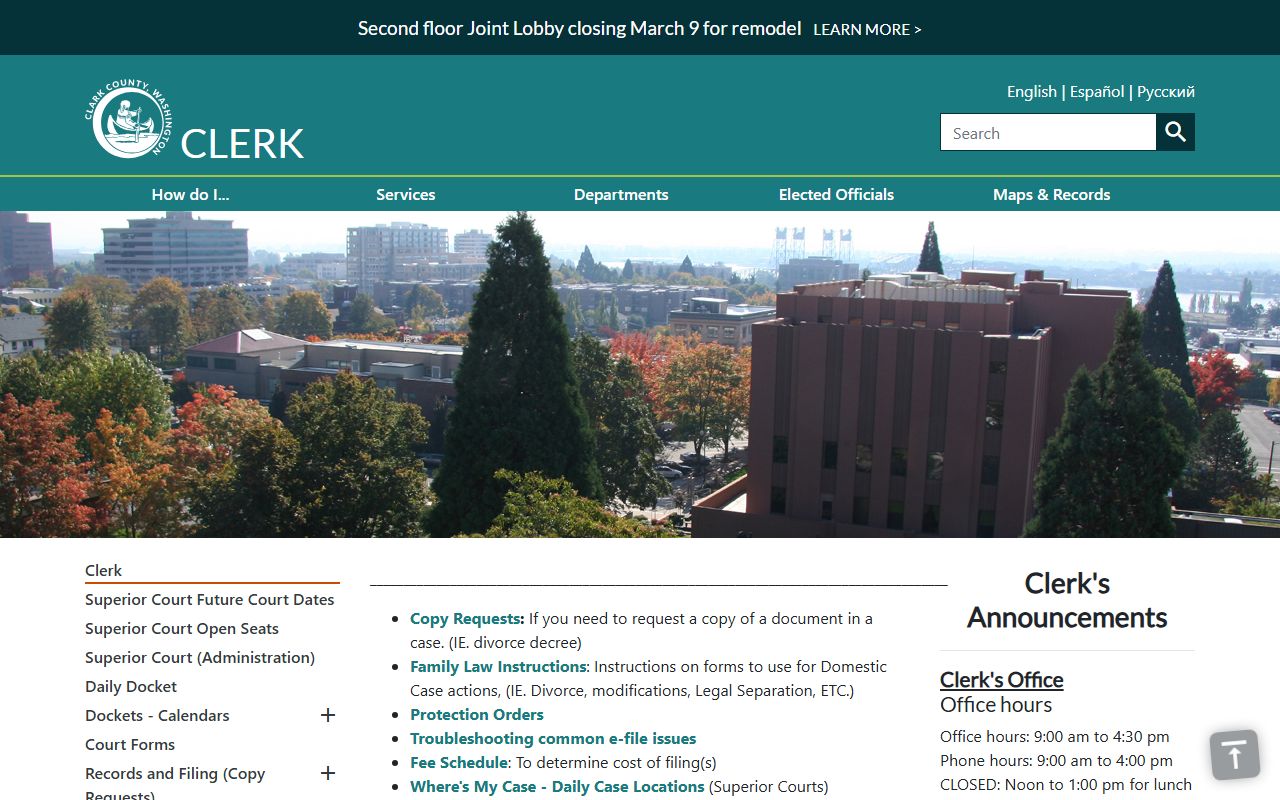
From the clerk's website, you can download the copy request form, find the email address for submissions, and review the full fee schedule for dissolution record copies.
The Clark County Access to Records page outlines the specific steps for requesting copies, including what information you need and how to send payment.
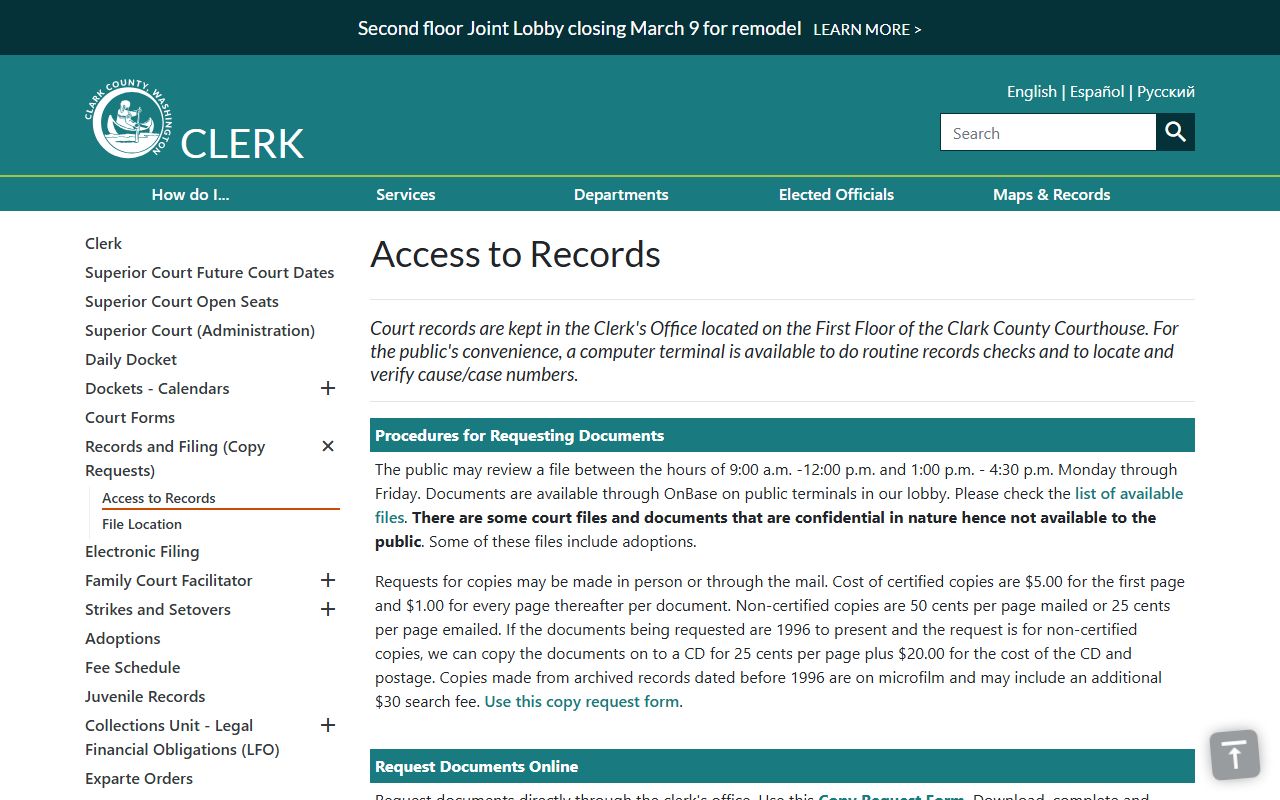
The access to records page lists all accepted methods: in-person, mail, and email. It also notes which records may require court order for access, such as sealed files.
The Clark County Superior Court records search portal allows online case lookups for dissolution and other case types.
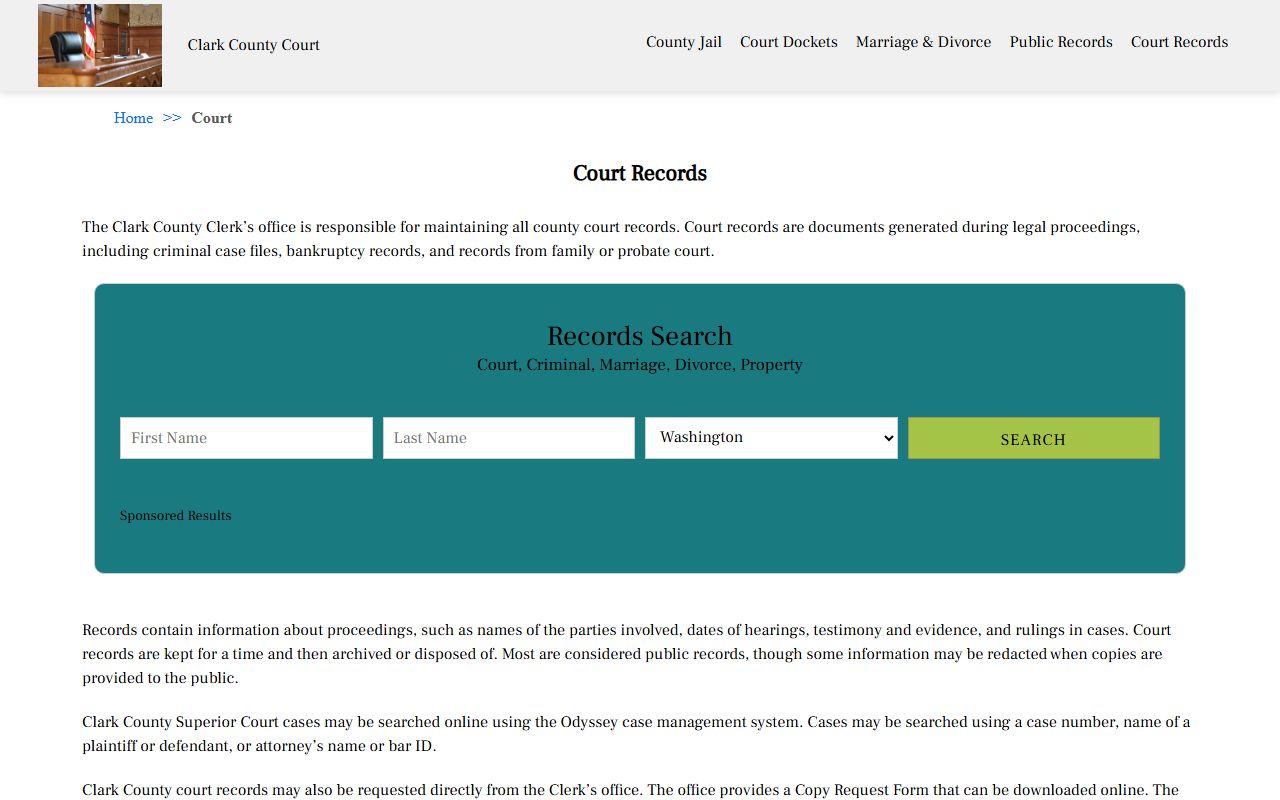
The court records search portal shows party names, filing dates, docket entries, and case status for dissolution cases filed in Clark County.
Copy Fees for Clark County Divorce Decrees
Clark County charges standard Washington State fees for copies of divorce decree records. Certified copies cost $5.00 for the first page and $1.00 for each page after that. Non-certified copies sent by mail cost $0.50 per page. If you want them emailed, the fee is $0.25 per page. Certified copies carry the official court seal and are accepted by courts, government agencies, and lenders as proof of the dissolution.
If you want records delivered on CD, the cost is $0.25 per page plus a $20.00 CD and postage fee. This option is only available for records from 1996 onward through the OnBase system. For archived records before 1996, there is an additional $30.00 search fee. For records predating 1979, expect a $30.00 research fee on top of any copy costs. These fees cover the extra time needed to locate and reproduce older records from microfilm.
Fee waivers may be available if you cannot afford the costs. Contact the clerk's office or check the Washington Courts forms page for the fee waiver application. You will need to show your financial situation. Courts generally approve waivers for those receiving public assistance or whose income falls below 200% of the federal poverty level.
Note: All fees are subject to change. Call (564) 397-2292 or check the clerk's website to confirm current rates before submitting your request.
Filing for Dissolution in Clark County
Dissolution cases in Clark County follow Washington State law under RCW Chapter 26.09. To file, at least one spouse must be a Washington resident or a member of the armed forces stationed in the state. Under RCW 26.09.030, there is no specific length of residency required in the county. You file in the county where you or your spouse lives.
Washington is a no-fault state. The only ground for dissolution is that the marriage is irretrievably broken. The court does not weigh fault. Either spouse can file and the other party cannot legally stop the dissolution from proceeding. The Petition for Dissolution and Summons are the first documents filed with the Clark County Clerk. The other party must be served or must sign a Joinder.
Washington requires a 90-day waiting period after the petition is filed and served. The case cannot be finalized before that period ends. If both parties agree on all terms, they can file an agreed decree and present it to the court. Contested cases may require mediation or go to trial. The judge signs the final Decree of Dissolution, which is recorded by the clerk and becomes a permanent court record.
Property is divided under community property rules set out in RCW 26.09.080. The court divides assets in a just and equitable way. If children are involved, a parenting plan and child support order are included in the decree. The Family Court Facilitator at the courthouse (1st floor, by appointment) can help with forms and explain the process for self-represented parties.
What a Clark County Divorce Decree Contains
A divorce decree from Clark County is a court order that ends the marriage. It is one of the most important documents in a dissolution case. The decree sets out the final terms agreed to or ordered by the court. Anyone who needs proof that a marriage ended, or who needs to enforce the terms of the dissolution, will need this document.
Clark County divorce decrees typically include the names of both parties, the document tracking number, the date the dissolution was finalized, and all terms of the legal dissolution. Property division terms, custody and residential schedule arrangements, child support amounts, and any spousal maintenance are all part of the decree. Attorney information, case initiation forms, and any motions or court orders filed during the case are also part of the full case file held by the clerk.
Certified copies of the Clark County divorce decree are needed for many purposes. Banks, lenders, and title companies may ask for one when dividing property. The Social Security Administration, DMV, and passport office also accept a certified decree as proof of name change or prior marriage. Keep at least one certified copy in a safe place after your case closes.
Note: Some records in Clark County may be sealed by court order. If a record you need is sealed, contact the Clerk's office for information on how to request court access.
Legal Help for Dissolution in Clark County
Several organizations offer legal help for dissolution cases in the Vancouver and Clark County area. If you need an attorney, the Washington State Bar Association has a lawyer referral directory. The Northwest Justice Project provides free and low-cost legal aid for qualifying residents. Call their CLEAR line at 1-888-201-1014 to find out if you qualify.
The WashingtonLawHelp.org website has self-help guides for dissolution, custody, and support cases. It covers the process step by step and links to all the forms you need. Official court forms are available at courts.wa.gov/forms. For those who cannot afford an attorney but want help with paperwork, the Clark County Family Court Facilitator (1st floor, courthouse, by appointment) offers guidance for self-represented parties.
For vital records in Clark County, note that marriage records are held by the Clark County Auditor, not the clerk. Birth and death certificates are handled by Clark County Public Health at 1601 E. Fourth Plain Blvd., Bldg. 17, 4th Floor. Their phone is (564) 397-8092. The Washington State Department of Health also maintains divorce certificates for cases from 1968 to present.
Cities in Clark County
Clark County includes Vancouver and surrounding communities. All dissolution cases for residents of the county are filed at the Clark County Superior Court.
Other communities in Clark County include Battle Ground, Washougal, La Center, and Ridgefield. All dissolution cases from these areas are handled at the Clark County Superior Court in Vancouver.
Nearby Counties
If you are unsure which county to file in, check where you or your spouse currently lives. You must file in the correct county under Washington law.